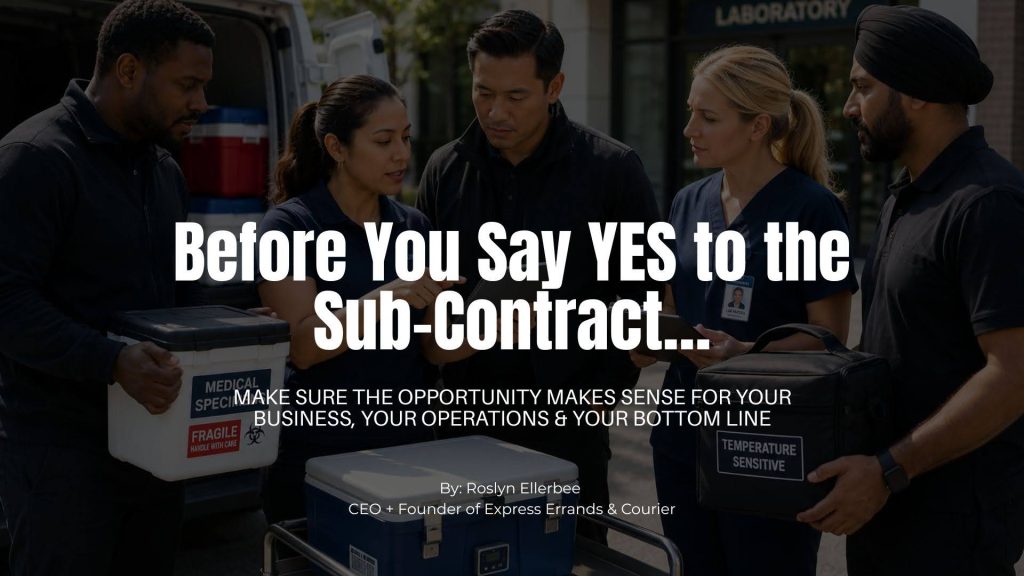
The Opportunity Can Sound Perfect—Until You Read the Requirements
The email lands in your inbox: A company is preparing a proposal for a medical courier contract and wants you to become its transportation partner.
The route is in your service area. The work is recurring. The opportunity involves medical specimens, prescriptions, or vaccines. You can already imagine what the contract could add to your monthly revenue.
Your first instinct may be to send a price immediately because you do not want the opportunity to go to someone else.
Slow down.
Subcontracting can be a smart way to enter a new market, build past performance, and create recurring revenue. It can also leave you responsible for expensive equipment, trained drivers, strict delivery windows, documentation, and service failures while another company controls the client relationship and payment.
In my years of building Express Errands & Courier, I have learned that a good opportunity must work operationally and financially. Being excited about the contract is not enough. Before I commit my company, my drivers, or my reputation, I need to understand what the work actually requires.
Here are nine questions every courier business owner should ask before agreeing to become a medical courier subcontractor.
1. Who Holds the Contract—and Who Controls the Client Relationship?
Start by understanding the structure.
Are you working for the government agency, healthcare organization, or laboratory directly? Or are you working for a prime contractor that holds the agreement?
If you are the subcontractor, the prime will usually control the client relationship, invoicing, and contract communication. Ask:
- Who will give EEC or your company daily instructions?
- Who approves route changes?
- Who handles complaints and service failures?
- Can you communicate directly with the end client?
- Will your company be named in the proposal or agreement?
- Can the prime replace you after using your qualifications to win the contract?
The answers should appear in writing. A friendly conversation is not a substitute for a subcontractor agreement.
2. What Is the Exact Scope of Work?
Do not price a summary. Price the actual work.
You need the complete route information, including:
- Every pickup and delivery address
- Days and frequency of service
- Pickup and delivery windows
- Average and maximum mileage
- Number of stops
- Expected wait time
- Average daily volume
- On-demand or STAT requirements
- Weekend and holiday coverage
- Start date and contract term
If you only receive an estimated mileage or general service area, make your price conditional until the exact route is confirmed.
A 50-mile route with five easy stops is not the same as a 50-mile route involving hospital parking, security desks, temperature checks, delayed releases, and a strict laboratory cutoff.
3. What Exactly Will You Be Transporting?
“Medical courier service” can describe very different work.
You may be transporting:
- Laboratory specimens
- Prescription medications
- Vaccines
- Medical devices
- Patient records
- Biological materials
- Temperature-sensitive products
Each category can involve different handling, packaging, training, documentation, and insurance requirements.
Ask whether the items are classified as exempt human specimens, Category B biological substances, hazardous materials, controlled substances, or regulated medical waste. Do not assume the client or prime contractor will supply everything you need.
4. Who Provides the Temperature-Control Equipment and Supplies?
If frozen, refrigerated, or controlled-room-temperature materials are involved, determine who supplies:
- Validated coolers or transport containers
- Ice packs or dry ice
- Temperature monitors or data loggers
- Tamper-evident materials
- Spill kits
- Replacement equipment
- Cleaning and disinfection supplies
Also ask who is responsible if the temperature moves outside the required range.
If you must purchase and maintain the equipment, those costs belong in your rate. Do not treat temperature control as a free add-on.
5. What Training and Credentials Are Required?
Confirm the requirements for every primary and backup driver.
Depending on the work, the client may require:
- HIPAA training
- Bloodborne Pathogens training
- Background checks
- Motor vehicle reports
- Drug screening
- Driver identification or uniforms
- Facility access credentials
- Chain-of-custody training
- Hazardous-material or specimen-handling training
- Specific insurance limits
Three years of company experience does not replace driver-level compliance. Build the time and expense required to recruit, train, credential, and maintain backup drivers into your pricing.
6. What Happens When the Regular Driver Is Unavailable?
A recurring medical route cannot depend on one person.
Before saying yes, identify:
- The primary driver
- At least one trained backup
- Who covers vacations and emergencies
- How quickly replacement coverage must arrive
- Whether backup drivers require advance approval
- What happens during severe weather or vehicle failure
If you do not have dependable backup coverage, you do not have a complete operating plan yet.
7. Does the Price Cover the Real Cost of Performing the Work?
Your price must cover more than mileage.
Calculate:
- Driver compensation
- Mileage and fuel
- Tolls and parking
- Vehicle requirements
- Dispatch and monitoring
- Technology and proof of delivery
- Insurance
- Training and background checks
- Coolers, supplies, and replacement equipment
- Backup-driver coverage
- Administrative time
- Unexpected waiting
- Your profit
Then calculate the weekly, monthly, and annual gross profit—not just the revenue.
If the prime contractor says your rate is higher than what it currently pays, do not immediately discount it. Ask whether you are comparing the same scope, qualifications, equipment, service standards, and response expectations.
Your responsibility is not to become the cheapest provider. Your responsibility is to determine whether your company can perform the work reliably and profitably.
8. When and How Will You Be Paid?
Payment terms can turn profitable work into a cash-flow problem.
Ask:
- Will you invoice weekly or monthly?
- Are payment terms Net 15, Net 30, Net 45, or longer?
- Does payment depend on the prime first being paid by the client?
- What documentation must accompany every invoice?
- Can payment be withheld for a missing POD or temperature record?
- How are on-demand requests, waiting, tolls, and added stops approved?
- Is there a fuel-surcharge provision?
- How are rate increases handled during a multi-year contract?
You may have to pay drivers, fuel, insurance, and operating expenses weeks before receiving payment. Make sure your cash flow can support the arrangement.
9. What Liability Are You Accepting?
Read the subcontractor agreement before you commit.
Look closely at:
- Indemnification
- Insurance limits
- Cargo liability
- Confidentiality
- Data and HIPAA responsibilities
- Service penalties
- Replacement costs
- Termination rights
- Non-solicitation provisions
- Exclusivity requirements
- Limitations on subcontracting
You should also understand whether you are expected to absorb losses caused by incorrect packaging, inaccurate instructions, temperature excursions, facility delays, or the prime contractor’s mistake.
When the potential exposure is significant, have your attorney or insurance professional review the agreement.
Red Flags That Should Make You Pause
Proceed carefully when:
- The prime refuses to provide the complete scope.
- You are pressured to quote before receiving the addresses.
- Payment depends entirely on the prime being paid.
- The rate does not cover required equipment and backup coverage.
- You are expected to provide references and qualifications without a written commitment.
- The prime wants to use your certifications but will not define your role.
- There is no written process for route changes or added work.
- The agreement makes you responsible for risks you cannot control.
Not every red flag requires an automatic no. It does require a question, a written clarification, or a change to the agreement.
The Mindset Shift: Access Is Not the Same as Alignment
Subcontracting may give you access to contracts you could not pursue alone. That can be valuable.
But access does not automatically mean the opportunity aligns with your business.
The goal is not to attach your company to every proposal. The goal is to choose work that fits your capabilities, protects your reputation, strengthens your past performance, and produces acceptable profit.
Sometimes the best business decision is yes. Sometimes it is yes—with conditions. Sometimes it is no.
All three can be CEO decisions.
Straight From My Playbook
Before I price a subcontracting opportunity, I create a simple qualification file containing:
- The complete scope of work
- Route map and schedule
- Driver and backup plan
- Compliance checklist
- Equipment requirements
- Cost and margin worksheet
- Client and prime-contractor responsibilities
- Questions requiring written answers
- Draft operating procedure
- Final go or no-go decision
That file helps me separate the excitement of the opportunity from the responsibility of delivering it.
What Happens After You Say Yes?
Winning or joining the contract is only the beginning.
Once you commit, you must prepare the drivers, document the route, define communication expectations, establish backup coverage, organize proof-of-delivery requirements, and protect the client relationship from the first day forward.
That is exactly what I teach in “Courier Business Operations: How to Manage Clients After Winning a Contract“.
This one-hour training takes you behind the scenes of Express Errands & Courier and walks you step by step through what needs to happen after a new client says yes. You will learn what information to collect, which questions to ask, what your team needs, and how to build the operation before service begins.
The training is $27 and includes lifetime access, so you can stop, pause, take notes, and revisit it whenever you need it.
GET LIFETIME ACCESS TO Courier Business Operations: How to Manage Clients After Winning a Contract